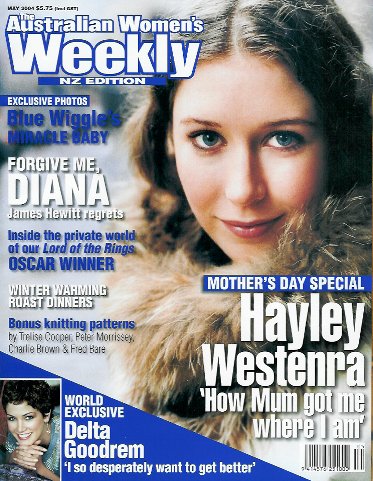
The article from Australian Women's Weekly NZ Edition May 2004.
The article from Australian Women's Weekly NZ Edition May 2004.
|
Hayley Westenra 'MUM made it all happen' Standing ovations on her latest tour, appearances on top-rating American TV shows, and more offers to perform than she can handle - 17-year-old superstar HAYLEY WESTENRA says she couldn't have done it without mum Jill. |
|
|
Jill Westenra never does anything by halves. When she was in fourth form and taking part in a cross-country race, a fiiend suggested they take it easy. "And I didn't want to," says Jill. "I wanted to keep going and stop when I wanted to stop. I Just kept running." Jill has passed this determination on to daughter Hayley. It's played a large part in the success of Hayley's singing career. Her album Pure has set all sorts of records - including the award of 10 platinum discs for New Zealand sales in February. Already the fastest-selling ever classical album in the UK, it is tipped to become, with the exception of The Three Tenors, the biggest-selling classical album ever, by the time its sales life is through.
Sitting at home in Christchurch this summer, Hayley ingenuously seems to have little idea of the magnitude of her success so far.
"It seems a bit unbelievable," she admits. "It's all happened so quickly. In some ways, when you're performing and in the midst of it all you take everything in your stride and are quite focused. But when you step back and look back at it, that's when it kicks in: 'Wow, I performed with Jose Carreras!' It's pretty cool.
"Its funny because I released my first album here when I was 14, and I'm 16, so it's only two years. [Hayley turned 17 in April.] It's not long from releasing my first album to singing with people like Bryn Terfel and Jose Carreras and for the Queen. It is a bit surreal."
In the latter half of this year, the entire Westenra family, Jill, Hayley, her dad Gerald and siblings Sophie, 12, and Isaac nine, will relocate to New York for the launch of Pure in the States. In March, Hayley appeared on the top-rating Good Morning, America and David Lettennan shows, and the first shipping of Pure for its April release was 250,000 copies. It will be mad, but Hayley can look ahead to a time when things will be able to move at a slower pace.
"I give it a couple more years and then it might slow down. This year will be America, then my next album will be coming out. Maybe it'll be five years before it'll slow down and l'll be able to say, 'No, I don't want to do that TV show,' and we'll keep it to a concert a week."
With the family tradition of hard work and doing the best you can at everything, it's no surprise that when Jill and Gerald were expecting their first child, Jill read every book she could find on pregnancy and babies, working her way through Christchurch's libraries as she depleted their stores of child manuals.
"I went into Adele Davis and was eating all this healthy food," says Jill, speaking, at her typical machine-gun speed, in the Fendalton house which is the only home the Westenra children have ever known. "I'd be drinking herbal teas that are good for extra nutrients, eating lambs' fry and salads. I was into having the healthiest baby."
Jill was attending teachers college at the time and exposed to numerous theories about early education. One thing she did from when Hayley was conceived was expose her to an enormous amount of classical music.
"Not so she'd become a musician," says Jill, "but because it's good for brain development. Even pushing a child on a swing helps brain development. If you want them to have a sense of calm, simple things like feeding the ducks help."
Jill says it was hard work keeping a tot as stimulated as Hayley was prepared to be. If they were going to the supermarket, and Hayley wanted to push the buggy, Jill would let her - which did nothing to shorten the time a shopping expedition took. But somehow Jill found the time to ensure that, whatever else Hayley's infancy was, it was never boring.
"I made cards with faces on because they like symmetry. We had mobiles galore. Someone from our playgroup was here and went to put her baby down in Hayley's room and said, 'How does she ever get to sleep?' But she did sleep, though she didn't sleep through the night the first two years - none of them did. We tried leaving them to cry, but it was too heart-wrenching. I couldn't do it."
Sophie and Isaac received the same treatment when they arrived in their turn. "Which is why I didn't want four," says Jill, "because we couldn't keep up."
Like most parents, Jill has particular ideas about bringing up kids. And, again like most parents, her ideas were influenced by her own childhood. Her mother lived through the Depression and, when Jill and her sister were young, went back to work to provide extras for them.
"We got weekly magazines," says Jill. (It was in one of these, Tammy, that she found the name Hayley.) "And if we went to the supermarket, we got a chocolate bar. On one income they couldn't do that. Most parents want to give their children a little more than they had themselves. I wanted my children to be happy and have wonderful memories of their childhood, like I had. I wanted them to have a full childhood where they had everything trips to the beach, to the mountains, seeing as much as possible of the countryside, going on boats and trains. We did the Alpine Express. This is a good place to give a full, rich childhood."
Jill gestures outside to the family's untended but much-loved garden. "Have you seen the hut? We have the playhouse and the tree house. I thought a jungle gym was important. I wanted the tree to have a swing, and now the rope has grown into the tree. I wanted them to have a magical childhood. So Hayley has had all that, and I think it's been a quite normal upbringing, and it's really helped her. I think it does help adults to have had a good childhood."
Hayley's composure and maturity have been widely noted. The stability of her upbringing can have played no small part in that.
But if Jill had expectations her daughter would grow into a confident adult, it never crossed her mind that she would become a singer, though there were some clues. Hayley's first public performance was at the age of two and a half. Fortunately, few people heard it.
"She sang 'Silent Night' right through during my sister's wedding. She was a flower girl and I was matron of honour. She just sang it quietly."
Jill says she has no memory of Hayley singing either more or less than any other toddler. "I never thought about her on stage. I was proud of my gorgeous children, I didn't need to think of them on stage. I was just enjoying that they were gorgeous. I was more concerned with her education and making sure they were immersed in books."
Jill says her children have all chosen their paths for themselves, and in that respect has a piece of advice for other parents. "Often children will lead you to what they're good at, if you let them try a lot of things," she notes. 'There'll be ones they don't like - ballet might have appealed for the dresses, but then it gets boring to them. At that point, if they're good at dance, you might say, 'Would you prefer jazz?' But if they're no good at all, you just say, That's fine. Try something else now.' They will go to what they're good at because that's what they enjoy. If you're hopeless at tennis, tennis is no fun."
However, as the years went by, it became abundantly clear that Hayley was good at music. At six she played the title character of her school's production The Littlest Star. Teachers commented even then on the unusual purity of her voice and the excellence of her ear. As she grew older, along with involvement in all sorts of school-based musical activities, ballet, and learning the violin and piano, Hayley became a regular on the talent quest round at Christchurch shopping malls, These contests helped her develop many of her skills as a performer. The experience had its frustrations. Hayley might, for instance, come second to a tap dancer or juggler.
"We'd always have a post mortem after," says Jill. "It was a hobby. We thought, what else can you do [to improve your chances]? So we tried to combine acting with dance - where appropriate, You couldn't do a ballet in the middle of an Andrew Lloyd Webber song, though I saw somebody get a choreographer in to do that once. We've seen our ideas copied. This lady came up to us once and said, Thank you for raising the standard of the contests.' "
Looking back, not always winning was probably good for developing robustness in Hayley. As for handling disappointment, Jill says, "It would have made a difference if she'd always got first as a young child. It probably is better the other way round."
Just as she threw herself into the early education and first steps in music, Jill was the driving force behind Hayley's first album, Walking in the Air. It was meant to be no more than a record of how Hayley sounded. Instead, it became the spark that ignited her international career.
"I was taken over by Hayley's CD," says Jill. "I was doing a painting course and I was sitting there and realised I couldn't concentrate on painting. I'd be thinking about the album artwork."
Jill enrolled in a photography course so she could do the photograph for the album's cover. Every aspect of this album was going to be the best the family could make it. And through every step of the process there was a lot of learning to be done, because none of them had ever done anything like this before.
"We were going to take these photos down at the beach," says Jill. "And I remember going five mornings in a row to see the sunrise. I thought what would be cool was something mystical, ethereal. One morning it was so misty, I thought this is perfect. I said to this lady who was walking her dog, 'This is amazing.' And she said, 'It is amazing, I've lived here three years and I've never seen it like this before.' Which was not what I wanted to hear.
"We dragged everyone down there before sunrise on the weekend. We packed all the home-made reflector gear, took everything down - and there was no mist. But we had breakfast and watched the sunrise with the kids, which was amazing for them." There's no such thing as a bad experience for Jill Westenra.
Having made the album, the family realised they had to sell it. "We went into stores and thought, what are they using to promote albums, and they had posters. So we had posters made. We gave them to the stores. And I went round at night putting them up. It's funny to think about now."
Walking in the Air led to a contract with Universal, for whom Hayley made two albums, and that in turn led to the deal with Decca UK which produced Pure, At some point, managing Hayley's career became a full-time job for Jill and then Gerald, who worked as a gemologist and jewellery retailer, though they don't exactly remember when.
For her part, Hayley acknowledges that without Jill she would not have had a career, Hayley had the talent, but Jill had the faith that encouraged her to use it.
"If Mum hadn't encouraged me, I wouldn't have thought, 'I can do this,' I think I always thought, 'Well, I'll try really hard, but I probably won't get there,' And Mum was the one who said, 'You can do this, Hayley. You've got the ability, why not go ahead and do it?'"
With the success of Pure and her imminent launch in the United States, Hayley clearly needed more experienced management. One of the most remarkable things about the Westenras is that they took Hayley so far with no experience, learning about things as they came up, The family considered several possible candidates before settling on industry veteran Steve Abbott, who has been with Hayley since the middle of last year.
"I don't know how we would have coped without Steve," says Hayley. "Mum and Dad are still heavily involved, but you need someone with experience in the music world. The workload that Steve takes on is just huge. I don't know how Mum and Dad could have looked after us and done all that."
"We're co-managing," says Jill. "It doesn't work with parents being managers. As much as we had the right ideas, we didn't have the confidence. Steve discusses stuff with us and in the end we end up agreeing."
Hayley knows how hard her parents work for her and tries in her own way to make things easier for them - not always successfully. "When I arrived in London last year," says Jill, "I had to go through her cases, and most of her clothes needed washing. Hayley thinks she's doing Gerald and I a favour by not putting it all out at once. She didn't want to shock us. I said, 'No, keep it out, so there's no nasty surprises like this,'"
In the lofty reaches of the music industry where Hayley now exists, Jill says that sometimes the worst person to be is "the mother". She recalls a meeting about Hayley's recording for a song for the Disney movie Mulan 2 where a conference call took place and no one at her end of the meeting mentioned she was there.
Decca management respects Hayley's family's close involvement, however, recognising that they are what keep her grounded and that without them she wouldn't be able to cope with the rigours of her international career.
There was nothing wrong with Hayley's equilibrium on her New Zealand tour. Her next release is a single of "Wuthering Heights" which appeared on Pure and of which she gave a blistering performance in Auckland in March. Ironically, the track - which Jill had introduced Hayley to almost never appeared on the album, having met with strong record company opposition. Hayley had to face down several music industry suits at a tense meeting in London, reaching for the tissues before Decca head Costa Filipacci finally said the decision was hers to make, noting record company executives only had jobs because of artists like Hayley.
Jill's response to the success of Pure is not what you might expect.
"I was just relieved, quietly excited, I probably exhaled," she says. "I'm not good at sitting back and enjoying it. There's still lots of work to do. I get greater satisfaction at getting through what has to be done and feeling like I've done a good job and contributed well, That's important to me.
"So many things have been weird, you wonder how much is out of your hands anyway. There's that thought our lives are mapped out, we just don't know about it yet, How much has been planned and we don't know?"
- PAUL LITTLE